Your air conditioner in a heatwave: set point, dehumidifying and settings that last the distance

The ClimExpertise team
30 Oct 2026 - 05 min to read
A heatwave puts your air conditioner to the test at the very moment you need it most. The outdoor unit has to reject heat into air at 35 or 38 °C, and its efficiency drops just as demand climbs. Poorly set, the unit becomes noisy, power-hungry and sometimes unstable. Well set, it holds a steady coolness without wearing itself out.
These settings are best prepared in advance: keep this guide for the next hot spell. It applies to a flat as much as to a shop, with a few nuances we point out along the way.
Why extreme heat makes the job harder
An air conditioner does not make cold: it moves heat from inside to outside. The hotter the outdoor air, the harder that transfer becomes. Condensing pressure rises, the compressor draws more power, and the available cooling capacity shrinks.
Three situations make it worse in the Paris region:
- an outdoor unit in full sun on a balcony or roof;
- a small courtyard or recess where the hot air it rejects is drawn straight back in;
- an outdoor coil clogged by pollution and spring pollen.
Every manufacturer gives a maximum outdoor operating temperature for cooling mode in the manual. Beyond it, or when the high pressure becomes excessive, the unit trips into safety mode and stops. It is not necessarily a fault, but it shows the unit is working at its limit.
The set point: 26 °C as a baseline, the gap as a guide
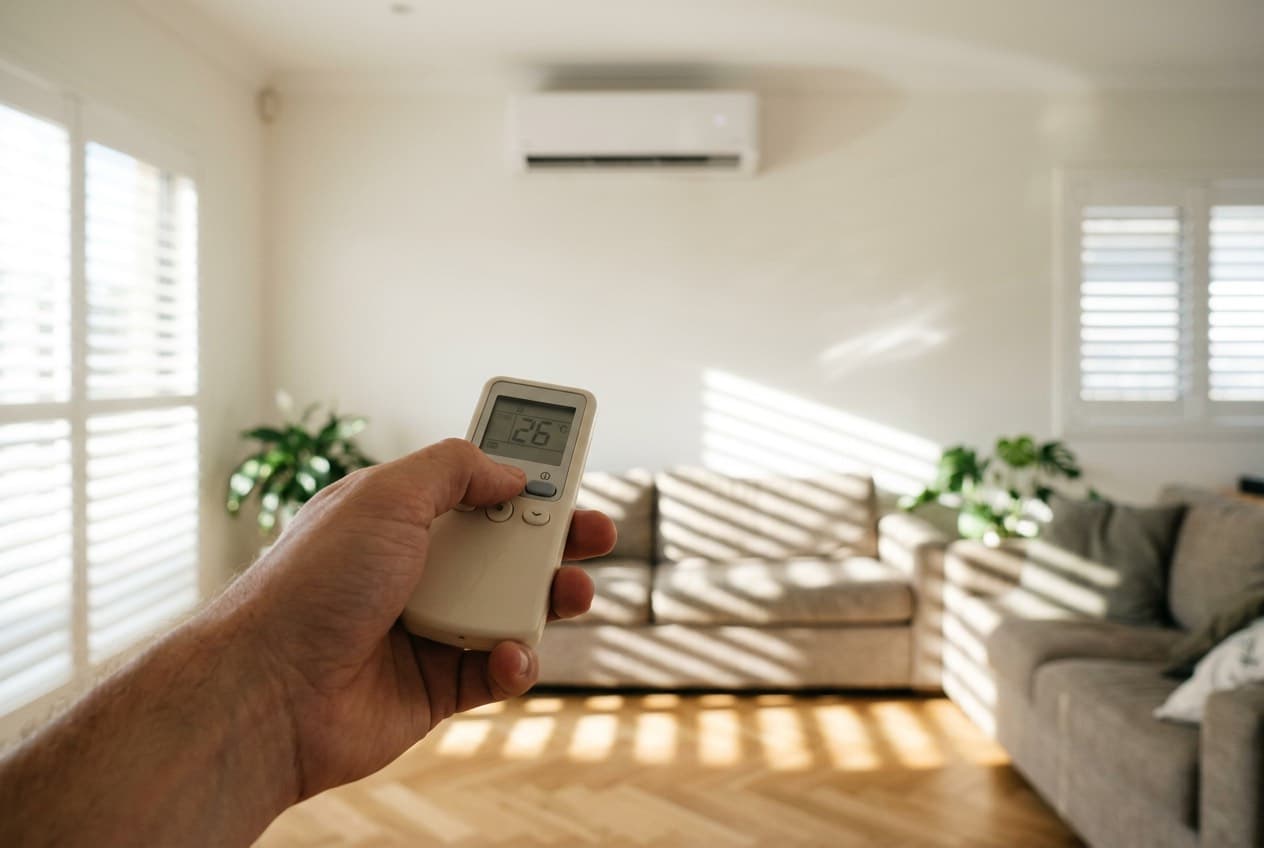
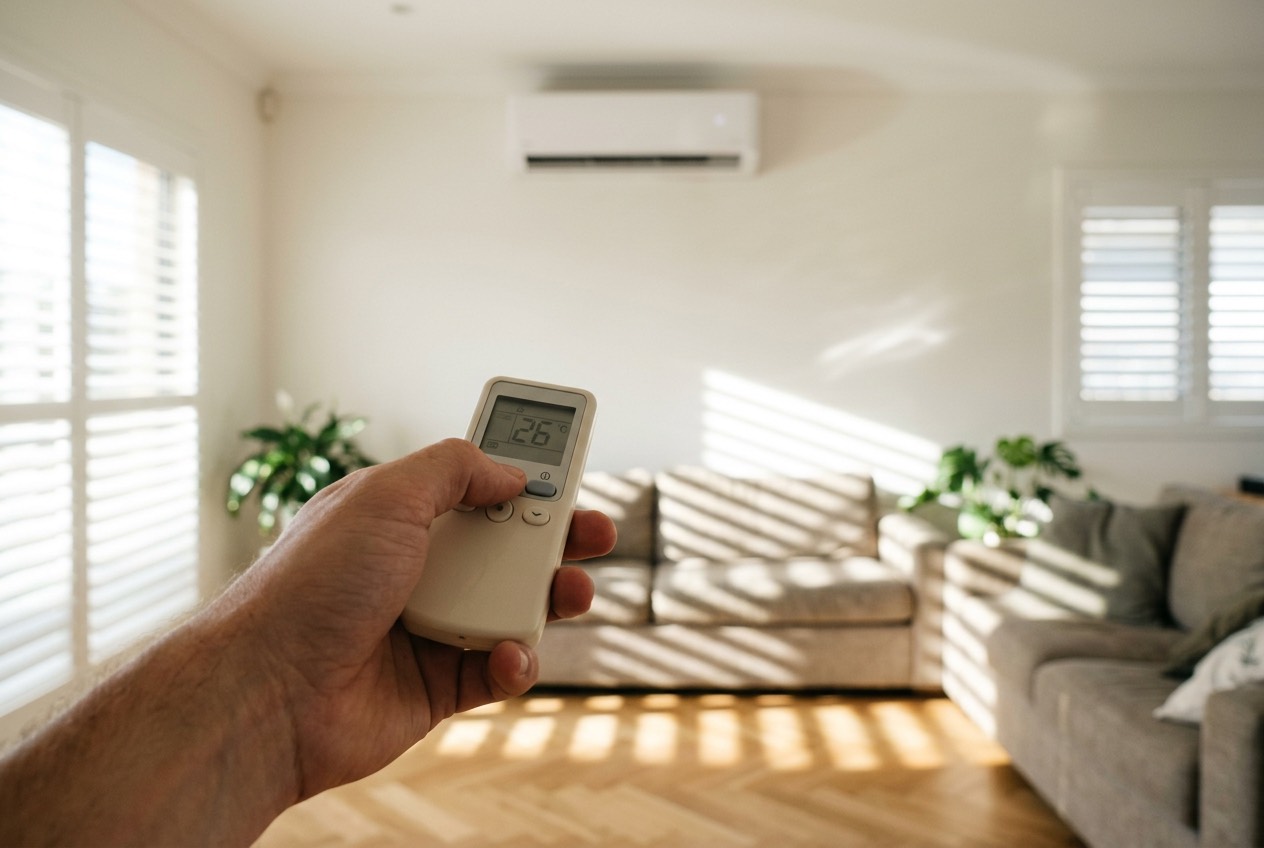
ADEME, the French environment and energy agency, recommends not setting air conditioning below 26 °C. According to a study carried out for the agency, moving from a 23 °C to a 26 °C set point can cut a home's cooling needs by a factor of three. That is a considerable saving for a modest difference in comfort.
The second rule matters just as much: keep the gap with outdoors to about 5 to 7 °C. Moving in and out between very different temperatures tires the body, especially for older people and young children.
| Outdoor temperature | Sensible set point |
|---|---|
| Around 30 °C | 25 to 26 °C |
| 32 to 34 °C | 26 to 27 °C |
| 35 °C and above | 27 to 28 °C |
For shops and offices, the French Energy Code (article R241-30) provides that cooling may only be switched on or kept running when the indoor temperature exceeds 26 °C. There are exceptions, notably for premises where care is given, those housing older people or young children, and those that must guarantee specific conditions.
One habit to drop: setting 18 °C to "cool down faster". An inverter air conditioner already runs at full power when the gap with the set point is large. A very low set point does not bring the temperature down any faster; it simply keeps the unit at full output for longer, until the room is too cold.
Dehumidifying: the forgotten setting
How hot you feel depends as much on humidity as on temperature. At 27 °C, dry air remains bearable; humid air quickly becomes oppressive. A relative humidity between 40 and 60 % is generally considered comfortable.
Dry mode (often shown as a water drop, or "Dry") sharply reduces the fan speed and runs the compressor in cycles. Air passes slowly over the cold coil, its moisture condenses and drains away, without the room cooling much. It is ideal in heavy, stormy weather, or in the evening when the temperature drops but the humidity lingers. It is less suited to intense dry heat: there, cooling mode is the right choice.
Even in cooling mode, fan speed affects humidity. A low speed dehumidifies better, a high speed cools more. A thermometer hygrometer placed away from the unit shows what is really happening in the room, so you can adjust rather than guess.
Directing the air, and helping it along
In cooling mode, set the louvres horizontally: cool air is heavier, falls naturally and spreads across the room. Avoid aiming the flow at a sofa, bed or desk; a constant cold draught causes stiffness and irritation.
Air movement improves how cool you feel. A quiet fan or a ceiling fan alongside the air conditioner often lets you raise the set point by a degree or two with no loss of comfort. The fan uses little power; every degree gained on the set point noticeably lightens the bill.
Running continuously or switching off: the right approach
With an inverter unit, steady operation at a sensible set point beats stopping and restarting in the middle of the afternoon. Restarting an air conditioner at 4 pm, when walls and furniture have soaked up the heat, forces it to run flat out for a long time.
- Out for a few hours: raise the set point to 28 or 29 °C rather than switching off.
- Away for a day or more: switch the unit off and close shutters and blinds.
- Morning: start early, while the outdoor air is still cool and the outdoor unit works in good conditions.
- Night: use night or sleep mode, which gradually raises the set point and lowers the noise.
In a shop, schedule start-up before opening rather than catching up with the heat in front of the first customers. The timer function or a programmer does this without you having to think about it.
Letting the outdoor unit breathe
The outdoor unit needs air. Respect the clearances given by the manufacturer, put nothing in front of or on top of it, and do not fit a tarpaulin or closed housing to "protect" it from the sun. Shade at a distance, which lets air move freely, can help; an enclosure that traps hot air makes things worse.
Avoid hosing the unit down too: tap water leaves limescale on the fins and can reach electrical components. If the coil is visibly dirty, cleaning it is part of servicing and a job for the air-conditioning technician.
Reducing heat before cooling
The best setting is still the one that asks the least of the unit:
- close east-facing shutters in the morning and west-facing ones in the afternoon; outside shading stops heat far better than an inside curtain;
- air the rooms widely at night and early in the morning, then close up;
- switch off anything that heats needlessly: oven, old lighting, devices on standby.
In a shop, a sun-facing window display and the lighting often account for most of the heat gains. Bringing them under control sometimes gets you through a heatwave without the unit reaching saturation.
Signs that call for a visit
Some symptoms are no longer a matter of settings:
- ice on the pipes or the indoor coil;
- water dripping from the indoor unit;
- an outdoor unit that stops and restarts repeatedly, or an error code;
- supply air noticeably less cool than before;
- a new noise, a clicking sound, a hot smell.
Switch the unit off, check the filters are clean and contact our air conditioner repair service. We usually attend within 24 to 72 hours in Île-de-France. For a shop whose trade depends on customer comfort, our maintenance contracts for businesses provide suitable follow-up.
Preparing for the next heatwave now
A unit serviced before summer faces the heat with clean coils and known baseline readings. That is the purpose of our active vigilance: we keep your air conditioner's history and get in touch before the season, so servicing is done before the first hot days.
Our air conditioner servicing and cleaning costs €130 including VAT for one indoor and one outdoor unit, with no call-out charge. Choose your slot on the booking page.
Have your air conditioner checked by an expert