Repair or Replace an AC Over 10 Years Old

L'équipe ClimExpertise
10 Nov 2026 - 08 min to read

An air conditioner almost never dies all at once. It starts cycling more often, drawing a little more power, making a new noise, and then one day it throws an error code and stops. In between, there are often two or three years during which you pay for repairs on a unit that will never return to its original performance.
The question "do I repair or replace?" is rarely settled by eye. It is settled with four pieces of information: the installation's actual age, the refrigerant it contains, its measured consumption, and the price of the parts still available. Here is how to gather these four elements and what they tell you, whether for an apartment or a commercial space.

Actual age, not perceived age
Most split air conditioners installed in the Paris region last between twelve and twenty years when they are maintained. Maintained means: coils cleaned, filters monitored, refrigerant charge checked, condensate drained properly. A unit that has never been opened since installation rarely reaches the top of that range.
To establish the actual age, don't rely on memory. Look at:
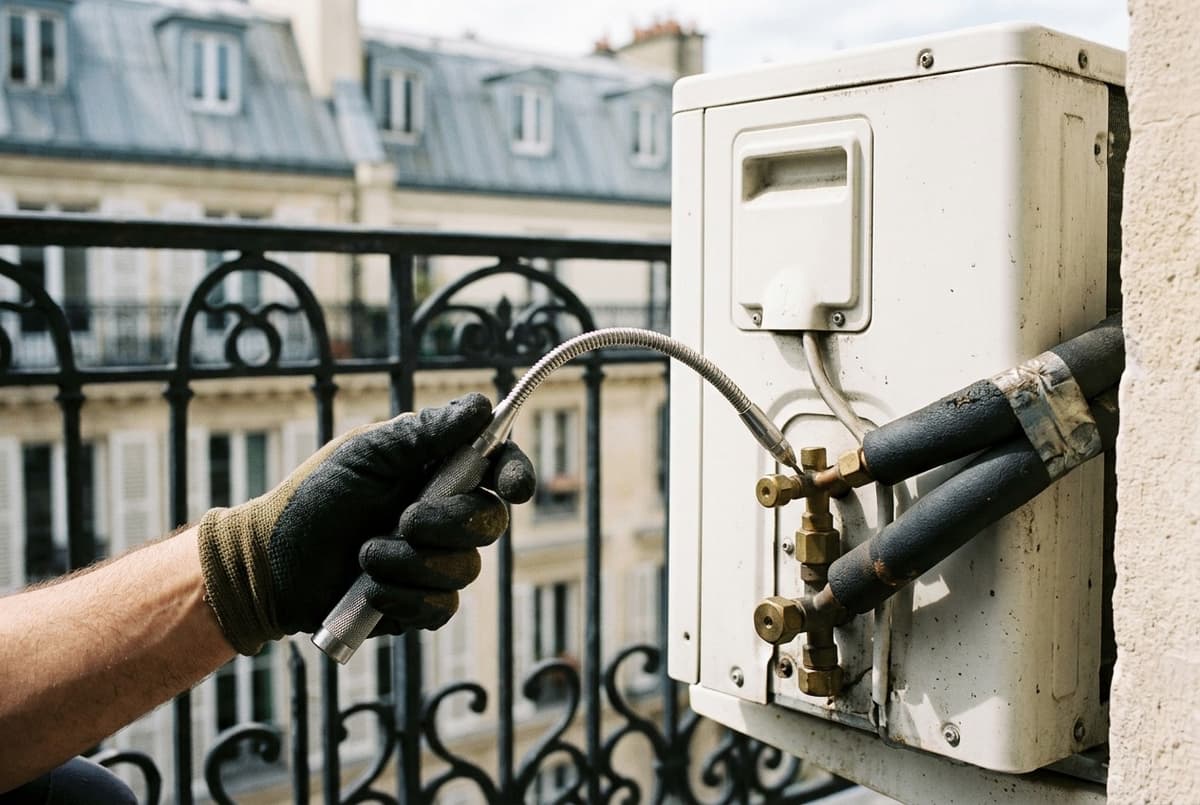
- the nameplate on the outdoor unit: brand, model, serial number, year or week of manufacture, refrigerant type and charge in kilograms;
- the installation invoice, if it still exists, which gives the commissioning date;
- the physical condition of both units: corrosion of the chassis, coil paint, cracked connection trunking, hardened and crumbling pipe insulation.
That last point matters a great deal in Paris. An outdoor unit in a courtyard, on a loggia or on a roof takes rain, dust and sometimes construction spatter. Two units of the same age can be in very different condition depending on their exposure.
A simple rule of thumb: under eight years, you almost always repair. Between eight and twelve years, it all depends on which part has failed. Beyond fifteen years, repair is only justified if it is minor and the rest of the installation is sound.
Refrigerant: the criterion that most often decides
This is the point many owners discover when the quote arrives. The refrigerant inside your unit determines whether repairing it is even possible.
Residential split systems installed in France up to around 2015-2018 generally contain R-410A. More recent units use R32, whose global warming potential is roughly three times lower. Regulation (EU) 2024/573 on fluorinated greenhouse gases, which came into application in March 2024, continues the gradual reduction of HFC quantities placed on the European market and sets a phase-out timetable for new equipment according to its capacity and GWP.
What this means for you in practice:
- a refrigerant subject to a quota reduction becomes scarcer and more expensive; recharging it after a leak costs more every year;
- recharging alone is prohibited when a leak is known and has not been repaired: the French environmental code requires repair before recharging, and the leak-tightness check must be redone after the work;
- so on a fifteen-year-old R-410A unit with a slow leak, you pay twice: once for leak detection, then for a refrigerant whose price keeps rising, with no guarantee it won't happen again next summer.
The rules on checks, record-keeping and CO2-equivalent tonnage thresholds are detailed in our article on leak-tightness checks and the F-Gas regulation. The one principle to remember here: an old unit that is losing refrigerant is a unit at the end of its economic life, even if it still blows cold.
A leak properly repaired on a sound circuit is a repair. A second leak on the same circuit within three years is a signal to replace.
Measured consumption, not estimated
This is where the gap between a 2010 unit and a 2026 unit becomes visible. You don't measure it by reading an energy label: you measure it on your own installation.
Two readings are enough to put facts on the table.
Current draw. Using a clamp meter, the technician measures the current drawn by the outdoor unit in steady-state operation and compares it with the nameplate rating. A current well above the rated value under normal conditions points to a compressor working too hard: fouled coil, incorrect charge, weak fan, or a tired compressor.
Supply/return air temperature difference. The technician measures the temperature of the air returning at the grille and that of the air being supplied. In cooling mode, on a residential split in good condition, the difference is often between 8 and 12 °C depending on the unit and the conditions. A collapsing temperature difference while current draw stays high means the unit is consuming without producing. How to read these lines in detail is explained in our article on the service report and its measurements.
Between visits, you can track two indicators yourself. A plug-in power meter or a metering module fitted on the air conditioner's circuit gives real consumption in kWh over a season, to compare from one summer to the next. And an indoor thermo-hygrometer placed in the main room shows whether the unit actually reaches its setpoint or runs non-stop without getting there.
A useful order of magnitude: moving from an older-technology split, with no variable speed or with a tired compressor, to a properly sized modern inverter split often cuts consumption by around 25 to 40% for the same comfort. That range depends on the unit, the home's insulation and the settings: it is no substitute for readings taken at your place, but it gives you the ballpark.

The price of parts: the three families of faults
Not all faults carry the same weight in the decision. It helps to sort them.
Minor faults: repair, no hesitation
Start capacitor, fan board, temperature sensor, remote control, condensate lift pump, louvre motor, display board. These parts are generally available and the cost stays moderate compared with a full replacement. On a ten-year-old unit that is clean and leak-free, repair is the right call.
Mid-range faults: do the maths
Outdoor unit fan, power board, expansion valve, four-way valve, locally pierced coil. Here the price of the part can account for a significant share of the price of a new installed unit. In that case a simple, honest rule applies:
| Situation | Reasonable decision |
|---|---|
| Repair < 30% of the price of a new installed unit, unit < 12 years old | Repair |
| Repair between 30 and 50%, unit 12-15 years old | Repair only if the rest of the installation is sound |
| Repair > 50% of the price of a new installed unit | Replace |
| R-410A refrigerant + recurring leak | Replace |
| Part unavailable from the manufacturer | Replace |
Major faults: almost always replace
Burnt-out compressor, corroded indoor coil, refrigerant circuit contaminated by moisture or oil residue after a failure. On a unit more than ten years old, replacing the compressor often costs a major share of the price of a new installed split, without restoring the rest of the circuit or the refrigerant lines.
Parts availability deserves a direct question to the technician: manufacturers do not guarantee supply forever, and on some entry-level models sold through big-box retailers, spare parts disappear quickly. The repairability index and parts-availability information, introduced under France's anti-waste law for a circular economy (loi anti-gaspillage pour une économie circulaire), help compare models when the time comes to choose a replacement.
What replacement really changes
Changing the unit isn't just swapping one box for another. It is the chance to fix what has been wrong since installation.
Sizing. Many older installations are oversized. An overpowered unit starts, cools quickly, stops, restarts: it dehumidifies poorly, wears out its compressor and creates cold-draught sensations. A capacity calculation done room by room, accounting for windows, orientation and insulation, often yields a lower capacity than the one in place.
Noise. Recent outdoor units are far quieter, and their night modes genuinely work. In a Paris apartment building, where noise at the property boundary and nuisance to neighbours are the leading causes of disputes, that is a concrete argument.
The refrigerant lines. You don't blindly reuse existing pipework when changing refrigerant. The diameter, internal cleanliness, insulation condition and oil compatibility all need checking. Replacing the lines costs more but avoids faults that would show up in the second year.
Heating. A recent reversible split heats efficiently in mild temperatures, which are common in the Paris region from November to March. A fifteen-year-old unit in heating mode often performs far worse. On some installations, it is the winter gain that pays for the replacement, not the summer one.

Before deciding: the diagnostic visit
A replacement quote that arrives without measurements is not a diagnosis. Before making the call, ask for a written report including:
- identification of the units (brand, model, serial number, refrigerant, charge);
- supply and return air temperatures, and the difference between them;
- current draw compared with the nameplate value;
- the condition of the coils, the drain pan and the condensate drainage;
- the result of a leak search if a loss of performance is suspected;
- the availability of the parts involved and their price.
With that document, the decision takes a few minutes, and it can be justified to a landlord, a building manager or an insurer. Our maintenance rates are published openly: €130 incl. VAT for one indoor unit and one outdoor unit, +€40 per additional indoor unit, +€70 per additional outdoor unit, 10% VAT in homes more than two years old, no travel charge in the Paris region. Installation, breakdown repairs and business contracts are covered by a free quote. For a breakdown call-out, the lead time is generally 24 to 72 hours.
If you keep the unit: the habits that extend its life
Deciding to repair also means accepting follow-up. On an older unit, three habits make a real difference.
Filters. A clogged filter pushes consumption up and the temperature difference down. Take it out, vacuum it with a soft-bristle vacuum brush, rinse it in lukewarm water and dry it completely before refitting. Every two to four weeks during periods of heavy use.
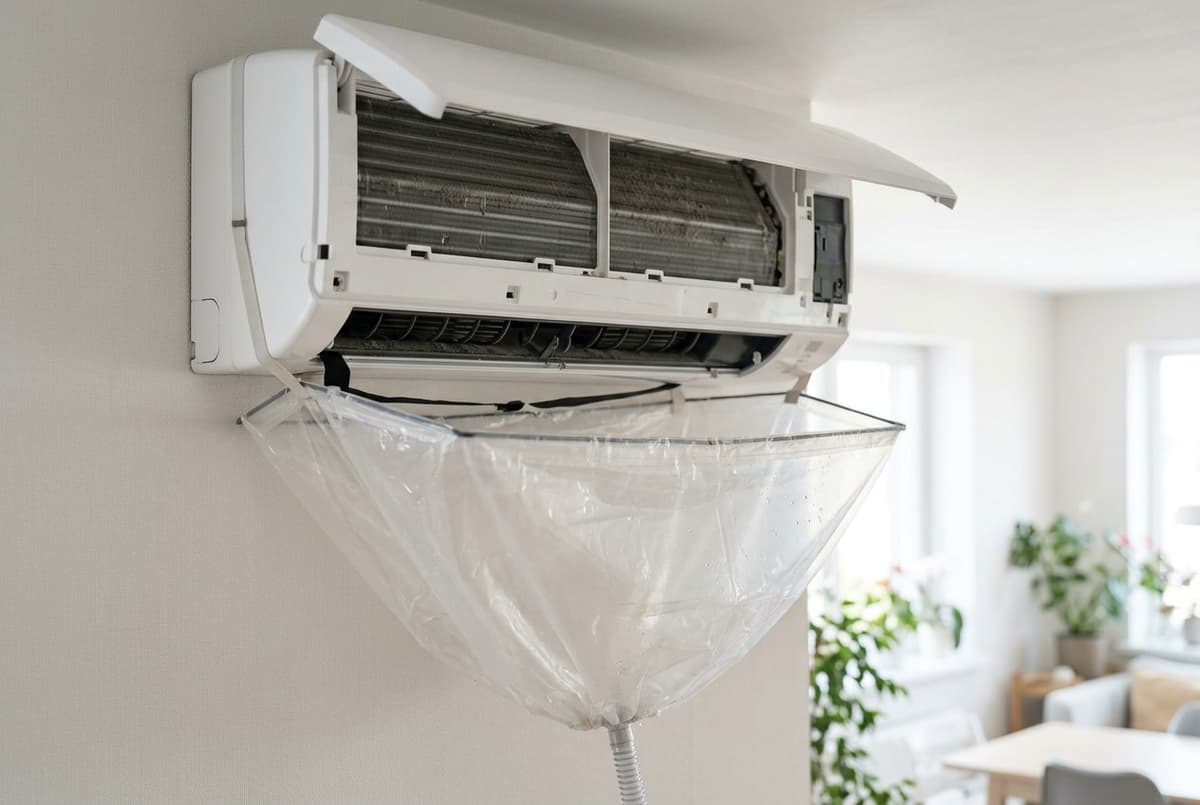
The coils. The outdoor unit needs to breathe: no cardboard against the grille, no climbing plants, no leaves piled up underneath. An air conditioner coil cleaning spray applied once a year to the outdoor coil, before the season, removes light dust. Deep cleaning of the blower wheel and the indoor drain pan remains a job for the technician, with dismantling and disinfection.
Condensate. A drain that drips or smells means a pan or a pipe to deal with right away. The causes and remedies are detailed in our article on air conditioner odours.
Alongside this, a temperature data logger placed in the main room keeps a record of real performance between visits. That is exactly the spirit of our active-monitoring follow-up: we compare what was measured last year with what is measured today, and warn you before the breakdown rather than after.
In summary
Four questions, in this order:
- How old is the installation really, and what physical condition are the two units in?
- What refrigerant does it contain, and has it already leaked?
- What is it consuming today, measurements in hand, for the comfort achieved?
- How much does the faulty part cost, and is it still available?
If all four answers are reassuring, repair: it is cheaper, and it is more responsible than throwing away a working unit. If at least two answers are worrying — particularly an old refrigerant with a recurring leak — replacement costs less over five years than a string of repair call-outs.
To have these measurements taken on your unit before you decide, you can book an appointment online or tell us about your situation for a free quote. And if you first want to understand your existing installation, the air conditioning maintenance hubs for the Paris region list our services department by department.
Have your air conditioner checked by an expert