Air conditioning a medical practice, therapy room or small office: comfort, hygiene and quiet

The ClimExpertise team
8 Nov 2026 - 05 min to read
A physiotherapy practice, a dental surgery, a nurses' office or a small four-desk office have one thing in common: people spend the whole day there, others wait there, and conversations concern no one but the patient or client. The air conditioner has to bring comfort without draughts, without distracting noise, and without becoming a hygiene issue.
These constraints differ from those of a home. Here is how to take them into account, from design to maintenance, whether for an independent practice or a small office.
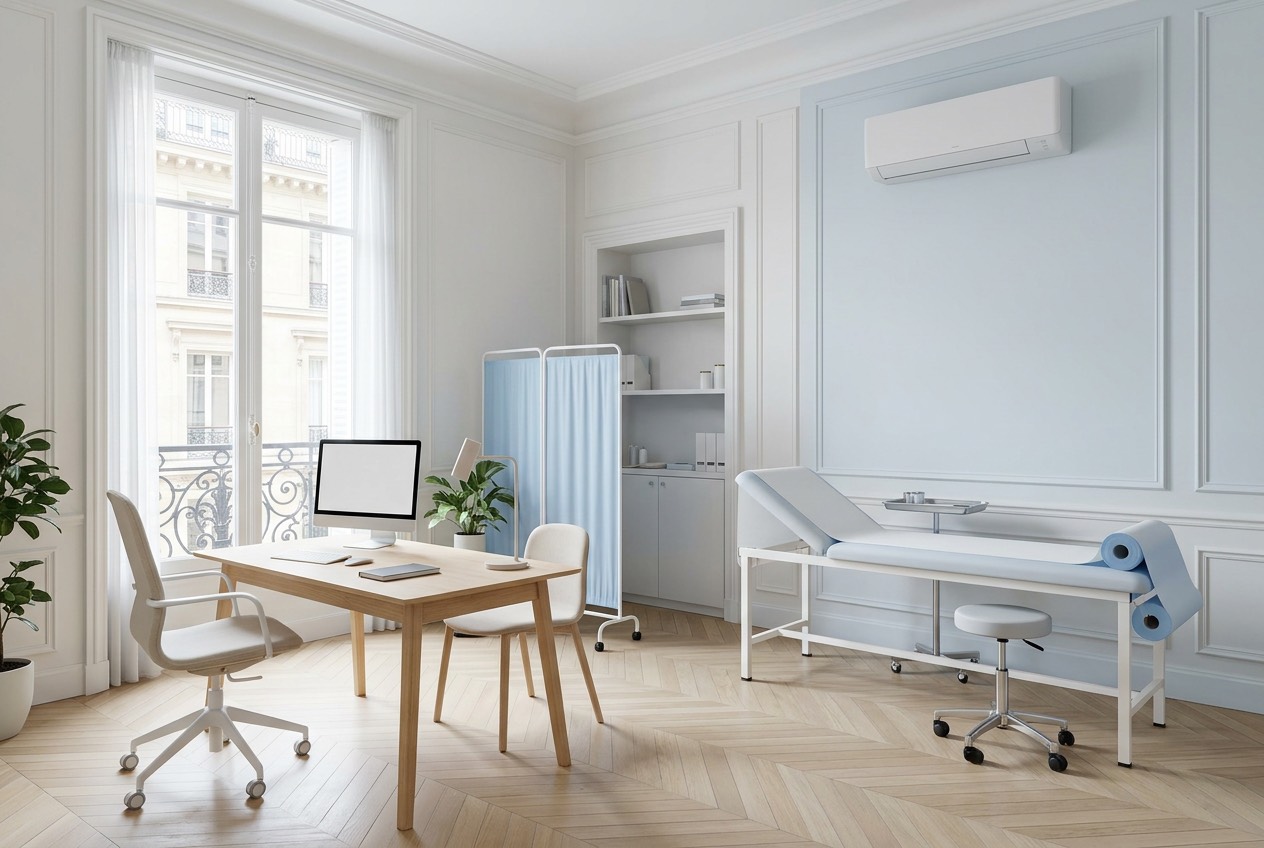
Needs that are nothing like a home's
In a practice, three comfort profiles share the space:
- the practitioner, active, often in a tunic, who tends to feel warm;
- the patient, still, sometimes partly undressed on an examination or treatment couch, who quickly feels cold;
- people waiting, whose number varies from hour to hour.
Heat gains are particular too: computers, printers, examination lamps, small sterilisation equipment in some specialities. In a small office, screens and desk density weigh most.
On the regulatory side, the French Energy Code rule that reserves cooling for premises above 26 °C does not apply to premises where care is given to non-hospitalised people (article R241-31). A practice can therefore set the temperature according to the needs of care. Restraint still pays: every degree shows on the bill.
Thinking room by room
A single powerful unit in the corridor serves nobody well. Comfort is managed room by room, with a control in each one.
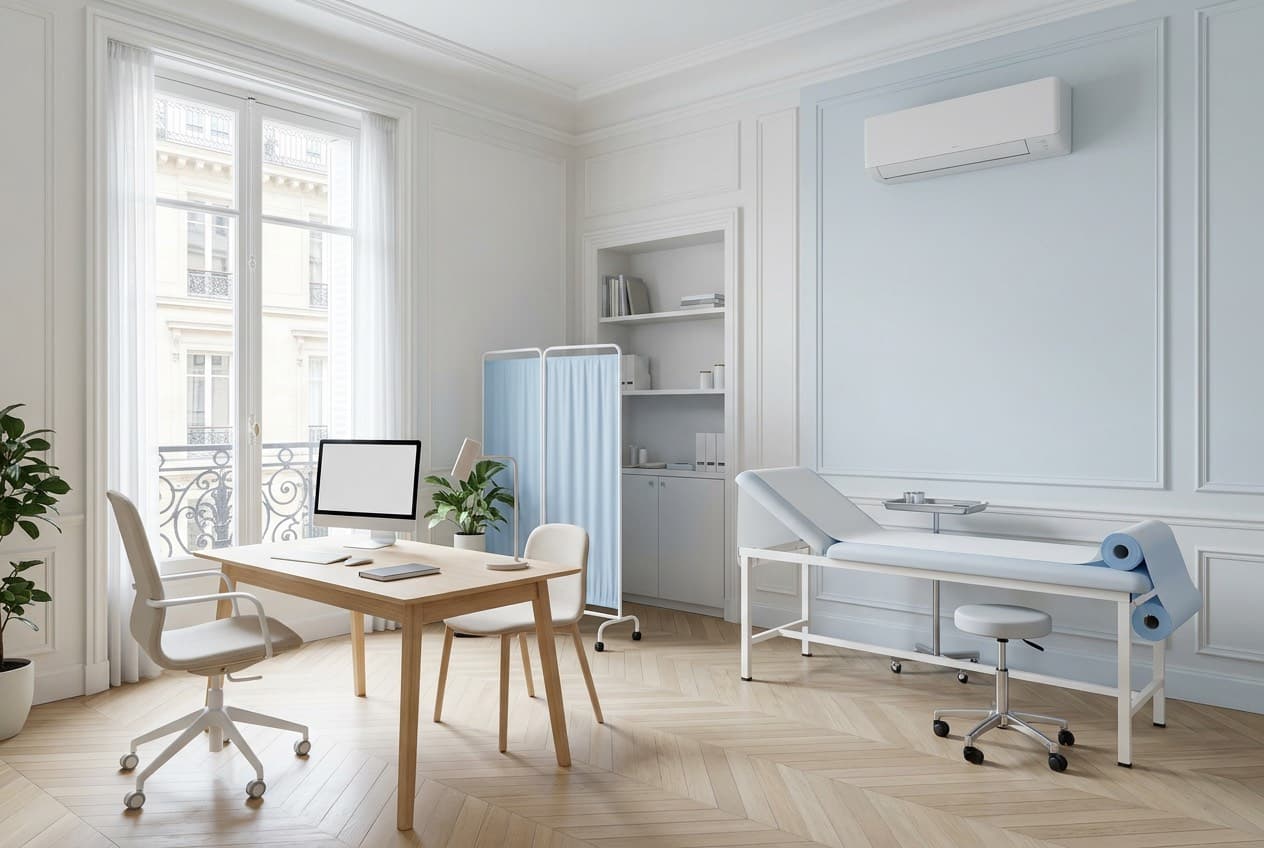
The treatment or examination room. Air must never fall onto the couch. The unit is positioned so that the airflow runs along the ceiling and spreads before reaching the treatment area. A gentler set point than elsewhere, often around 24 to 26 °C in summer, suits a patient lying still. In winter, a reversible model warms the room quickly before a session.
The waiting room. Occupancy fluctuates: an inverter unit, which modulates its output, avoids on-off cycles and temperature swings.
Reception and offices. Airflows are directed towards circulation areas, not desks. In a small office, two modest, well-placed units are often better than a single oversized one.
Depending on the layout, the choice is between several independent splits, a multi-split (one outdoor unit for several rooms) or, in a suspended ceiling, cassettes that spread air in four directions. The technical survey before installation is there precisely to decide.
Scheduling around opening hours
A practice or office is only occupied for part of the week. There is no point cooling empty rooms in the evening, at weekends or during holidays. Most recent air conditioners offer weekly scheduling, from the remote or an app: start half an hour before the first patient arrives, stop at closing time, set point raised over lunch if the practice closes.
This simple setting avoids oversights, limits consumption and guarantees a comfortable room at opening. Remember to review it whenever hours or seasons change, and to lock the controls in rooms open to the public if your model allows it.
Quiet: a matter of care and discretion
A hum that is acceptable in a living room becomes intrusive in a 12 m² consulting room or during a relaxation treatment. Data sheets give the indoor unit's sound level for each fan speed: compare the values at low speed, the one that will run most often.
Confidentiality is often overlooked. Refrigerant pipes pass through partitions; if the openings are not carefully sealed, they let voices travel from one room to the next. We treat these penetrations as an acoustic matter in their own right, not a finishing detail.
Outdoors, the unit must respect the neighbours' peace. The French Public Health Code limits equipment noise through a maximum emergence over background noise, stricter at night than during the day. Location, distance from neighbouring windows and anti-vibration pads do most of the work.
Hygiene: what the air conditioner does, and what it does not
A split air conditioner treats the room's air: it cools or heats it, and dries it in summer. It does not renew it. Fresh air remains the job of the premises' ventilation and of opening windows between patients.
Its standard filters mainly stop coarse dust. Some models offer finer filters, but no wall-mounted air conditioner replaces medical-grade air treatment equipment. In a waiting room, a portable HEPA air purifier can complement the setup.
For installation and use, a few simple rules:
- do not place the unit above the treatment couch, a worktop or a preparation area;
- avoid airflow passing from one chair to another, or from a patient towards the practitioner;
- route the condensate drain away from workstations;
- have the filters washed monthly during the season, by the team or at visits, and note it in a maintenance log.
Lease, building and planning: questions to ask before installation
Many practices and small offices in the Paris region occupy a ground floor or a flat in a residential building. Before any installation:
- check the professional or commercial lease: the landlord's written consent is usually required;
- in a co-owned building, an outdoor unit on the façade, in a courtyard or on a shared roof usually requires approval from the general meeting of co-owners;
- depending on the location and external appearance, a prior declaration to the town hall may be required, with stricter rules in Paris's protected areas.
These steps take weeks, sometimes months. It is better to start in winter so you are equipped before summer.
Maintenance matched to footfall
A practice receives the public all day: dust and humidity are more present than in a home. One visit a year is a minimum; two a year suit high footfall or a sensitive speciality better. We schedule them outside consulting hours, early in the morning, at lunchtime or on a closing day.
Every visit ends with a written report: useful for your own quality follow-up, and to prove maintenance to a landlord. If the practice has a multi-split with a large refrigerant charge, check whether it is subject to periodic leak checks.
Between visits, a thermometer hygrometer in the waiting room helps you spot a room that is too dry or too humid, and adjust the settings.
What we offer practices and small offices
For an installation, we carry out a technical survey and a free quote, room by room. For existing equipment, our maintenance contracts for businesses set the pace of visits and bring the reports together. Our active vigilance keeps each unit's history and gets in touch before the season or before a check falls due: you have no dates to keep track of.
Unsure about the right unit or location? Our advice and support service helps you decide. For a quote, write to us via the contact page; for straightforward servicing, choose your slot on the booking page.
Have your air conditioner checked by an expert