Leak checks and the F-Gas regulation: who needs their air conditioner checked, and how often?

The ClimExpertise team
2 Nov 2026 - 05 min to read
"Does my air conditioner need a leak check?" The question comes up often, from households and shopkeepers alike, and the answer depends neither on the brand nor on the age of the unit. It depends on a simple calculation: the amount of refrigerant it contains, multiplied by that refrigerant's climate impact.
The calculation comes from European Regulation (EU) 2024/573 on fluorinated greenhouse gases, known as the F-Gas Regulation, which has applied since 11 March 2024. Here is how to tell whether your home or your business is affected, how often, and what you need to keep.
Servicing and leak checks: two separate things
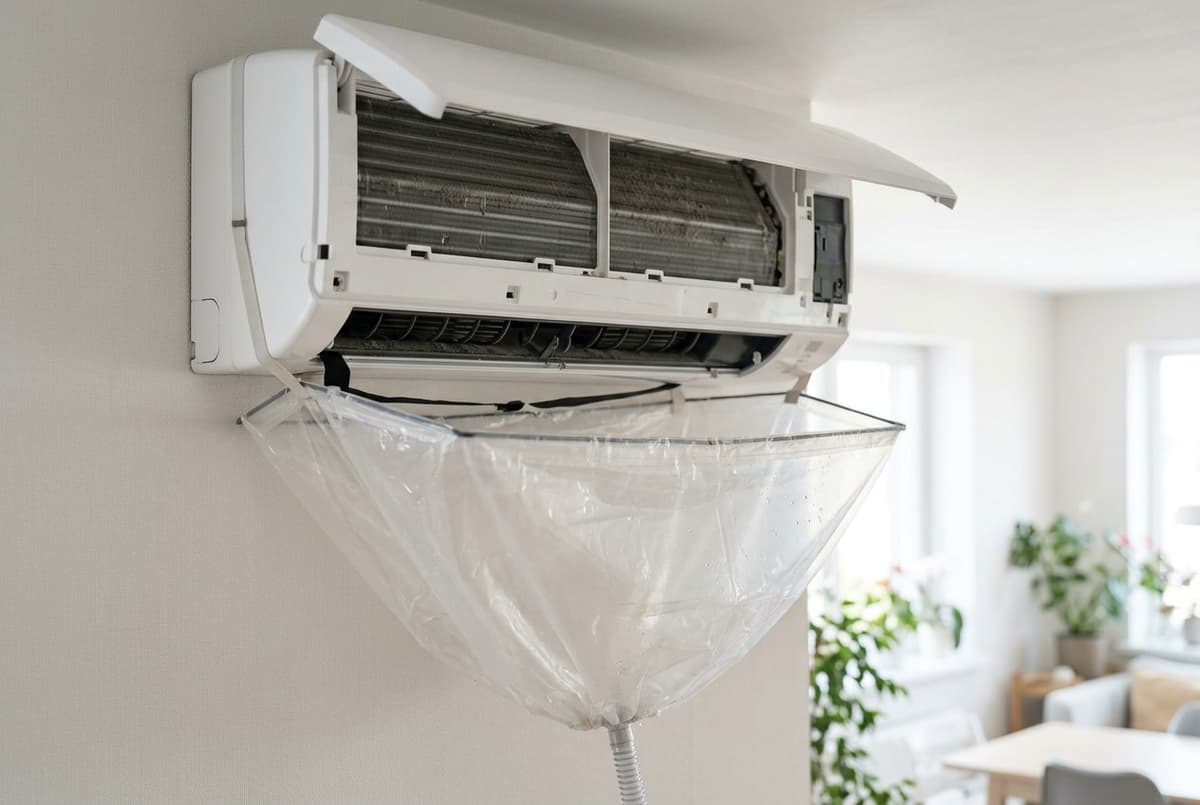
The two are often confused. Servicing means cleaning the unit, measuring how it performs and spotting wear. It is strongly advised for every air conditioner, as it protects efficiency, hygiene and service life.
A leak check is a targeted legal obligation. Its purpose is to detect leaks of refrigerant, fluorinated gases whose greenhouse effect is far greater than that of CO2. It only concerns equipment above a certain threshold, and must be carried out by a certified person working for a company that holds the French refrigerant handling certificate (attestation de capacité).
In practice, both are often done during the same visit. But they have neither the same purpose nor the same mandatory status.
The calculation: from kilos to tonnes of CO2 equivalent
The threshold is not expressed in kilos but in tonnes of CO2 equivalent. The formula:
tonnes CO2e = charge in kg × refrigerant GWP ÷ 1,000
GWP (global warming potential) measures the impact of one kilo of refrigerant compared with one kilo of CO2. The values to use are those set in the regulation:
| Refrigerant | GWP | Charge equal to 5 t CO2e |
|---|---|---|
| R32 | 675 | about 7.4 kg |
| R-410A | 2,088 | about 2.4 kg |
| R-454B | about 466 | about 10.7 kg |
| R-290 (propane) | very low, not fluorinated | not concerned |
Two telling examples:
- a wall-mounted R32 air conditioner usually holds well under 2 kg of refrigerant: far below 5 tonnes, so no mandatory periodic check;
- an R-410A multi-split charged with 3 kg represents about 6.3 tonnes: it must be checked at least once a year.
Watch out for the actual charge. The rating plate shows the factory charge, but when the pipes between units are long, the installer adds refrigerant at commissioning. It is the total charge that counts, and it should appear on the intervention form drawn up at installation. Each independent refrigerant circuit is assessed separately: three separate R32 splits are not added together.
The required frequencies
Once the charge is known, article 5 of the regulation sets the minimum frequency:
| Equipment charge | Without leak detection system | With leak detection system |
|---|---|---|
| Under 5 t CO2e | No mandatory periodic check | No mandatory periodic check |
| 5 to under 50 t CO2e | At least every 12 months | At least every 24 months |
| 50 to under 500 t CO2e | At least every 6 months | At least every 12 months |
| 500 t CO2e or more | At least every 3 months | At least every 6 months |
From 500 tonnes, a leak detection system becomes mandatory for stationary air-conditioning installations; this level mainly concerns large commercial buildings.
Hermetically sealed equipment, labelled as such, is exempt below 10 t CO2e, and below 3 kg when installed in a residential building. A standard split does not usually fall into this category: its connections are made on site during installation.
Who is responsible: the operator
The regulation places the obligation on the operator, meaning the person who exercises actual power over the technical functioning of the equipment. For an owner-occupier it is simple: that is you. In a rented home or commercial premises, the answer depends on the lease and on who actually controls the unit. The safest course is to put it in writing in the contract.
The operator of equipment subject to checks must:
- have the checks carried out on time, by an authorised company;
- have any detected leak repaired without undue delay;
- have the repair verified, no earlier than 24 hours and no later than one month afterwards;
- keep a record for each piece of equipment (refrigerant, quantities added or recovered, interventions, check results) and retain it for at least five years;
- keep the intervention forms issued after every handling of refrigerant.
Records can be digital, but a ring binder with sleeves kept for each unit remains a simple way to hold forms, reports and invoices in one place, ready to show in case of inspection.
What a check involves
A proper leak check is more than "waving a device around". The air-conditioning technician:
- inspects the circuit visually for oil traces, corrosion or abnormal vibration;
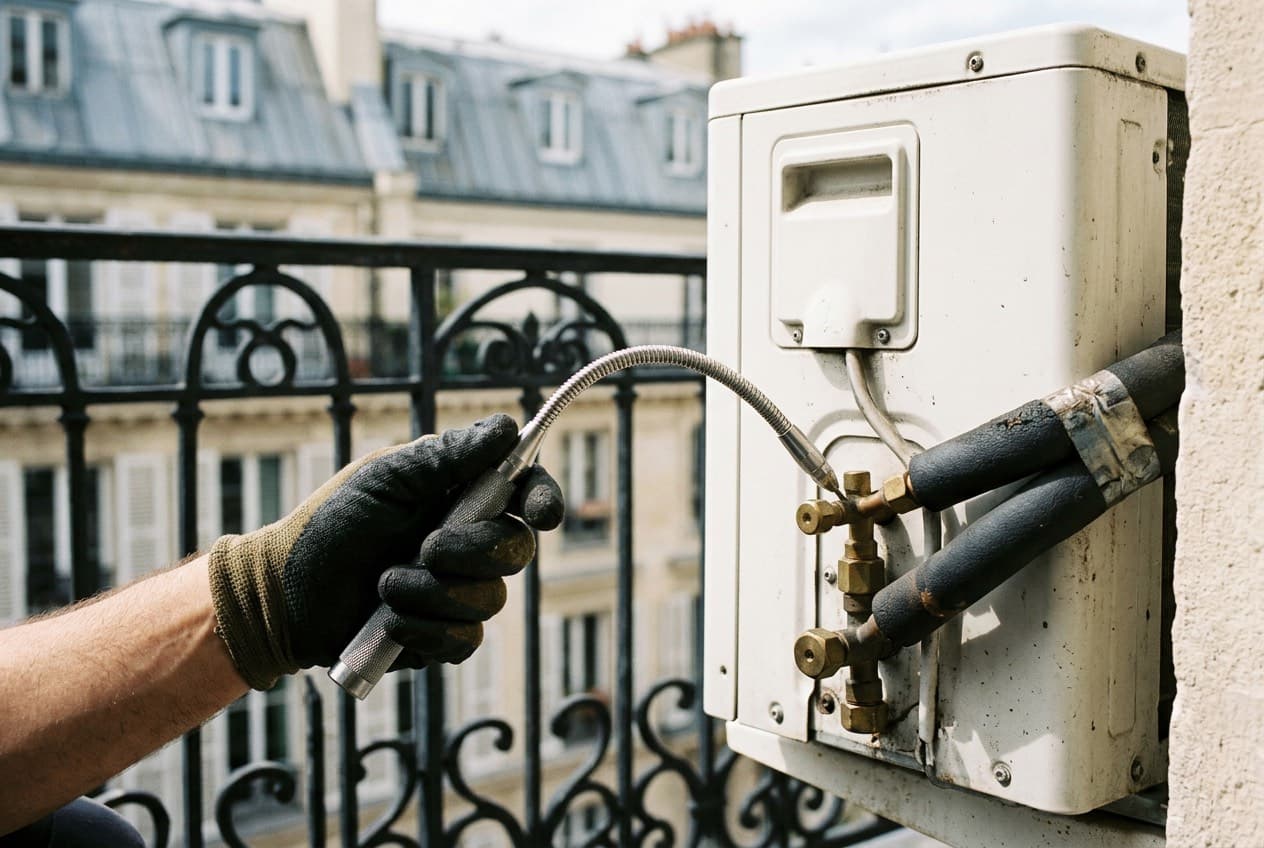
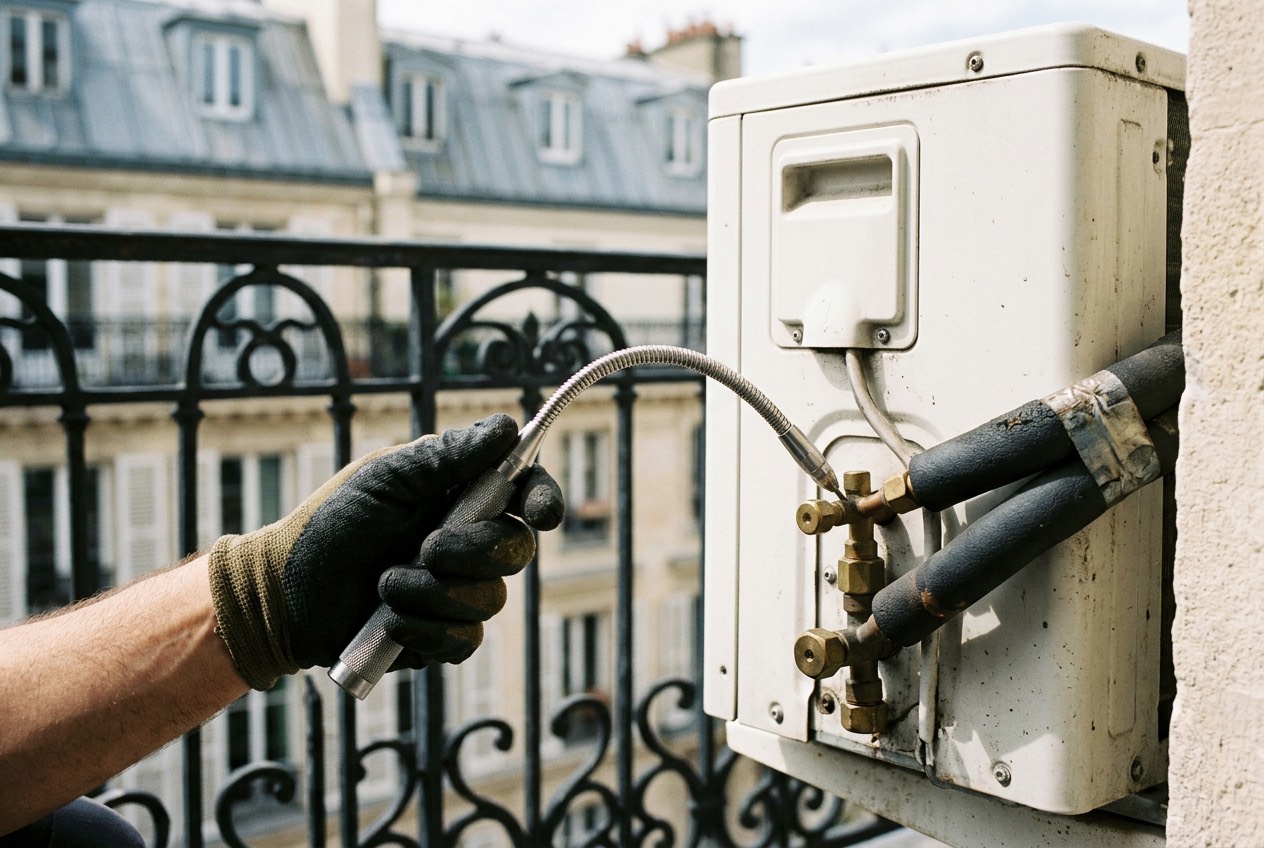
- runs a calibrated electronic detector over the sensitive points: connections, valves, brazed joints, capillaries;
- confirms with a bubble solution where needed;
- checks that operating readings are consistent with previous ones;
- records the result and the next due date.
If a leak is found, it is located and repaired, then the circuit is evacuated and recharged with the exact quantity. Topping up without repairing makes no sense: the refrigerant would simply escape into the atmosphere again. We explain how to read pressures and other readings in our guide to reading your air conditioner service report.
Households: rarely affected, never outside the rules
Most home air conditioners stay below the 5-tonne threshold. That does not make them a free-for-all:
- any handling of refrigerant is restricted to companies holding the refrigerant handling certificate;
- every intervention on the circuit gives rise to an intervention form, which you should keep;
- when a unit is removed or replaced, the refrigerant must be recovered, never released.
One detail is worth knowing: an older R-410A multi-split, common in houses and large flats, quickly exceeds 2.4 kg. Check its rating plate and its commissioning form.
Shops and offices: take stock
For a shop, a practice or an office, the approach is methodical:
- list every unit and every circuit;
- note the refrigerant and factory charge from the plate, then any additions recorded at commissioning;
- calculate the tonnes of CO2 equivalent;
- schedule the due dates and open a record for each unit;
- entrust follow-up to a company that keeps the history.
Our maintenance contracts for businesses and for commercial buildings include this scheduling.
Bans on placing on the market, in brief
The F-Gas Regulation also phases out the highest-impact refrigerants. Since 1 January 2025, single split systems containing less than 3 kg of a refrigerant with a GWP of 750 or more can no longer be placed on the market: that marks the end of new small R-410A splits. From 1 January 2029, air-to-air splits up to 12 kW using a fluorinated gas with a GWP of 150 or more will in turn be banned, unless required for safety.
These bans apply to new equipment. An air conditioner already installed can keep running and being serviced. To decide whether an older unit is worth repairing or replacing, our advice and support service helps you choose on measured grounds.
No more keeping track of due dates
Remembering a check date every twelve months is tedious, especially with several units. Our active vigilance keeps each unit's history, charge and results, and we get in touch before your next leak check falls due. Every visit ends with a written report and, whenever refrigerant is handled, the statutory intervention form.
For servicing with leak detection, choose your slot on the booking page; for a site with several units, ask for a free quote via the contact page.
Have your air conditioner checked by an expert