Your air conditioner service report: understanding every reading, line by line

The ClimExpertise team
27 Oct 2026 - 06 min to read
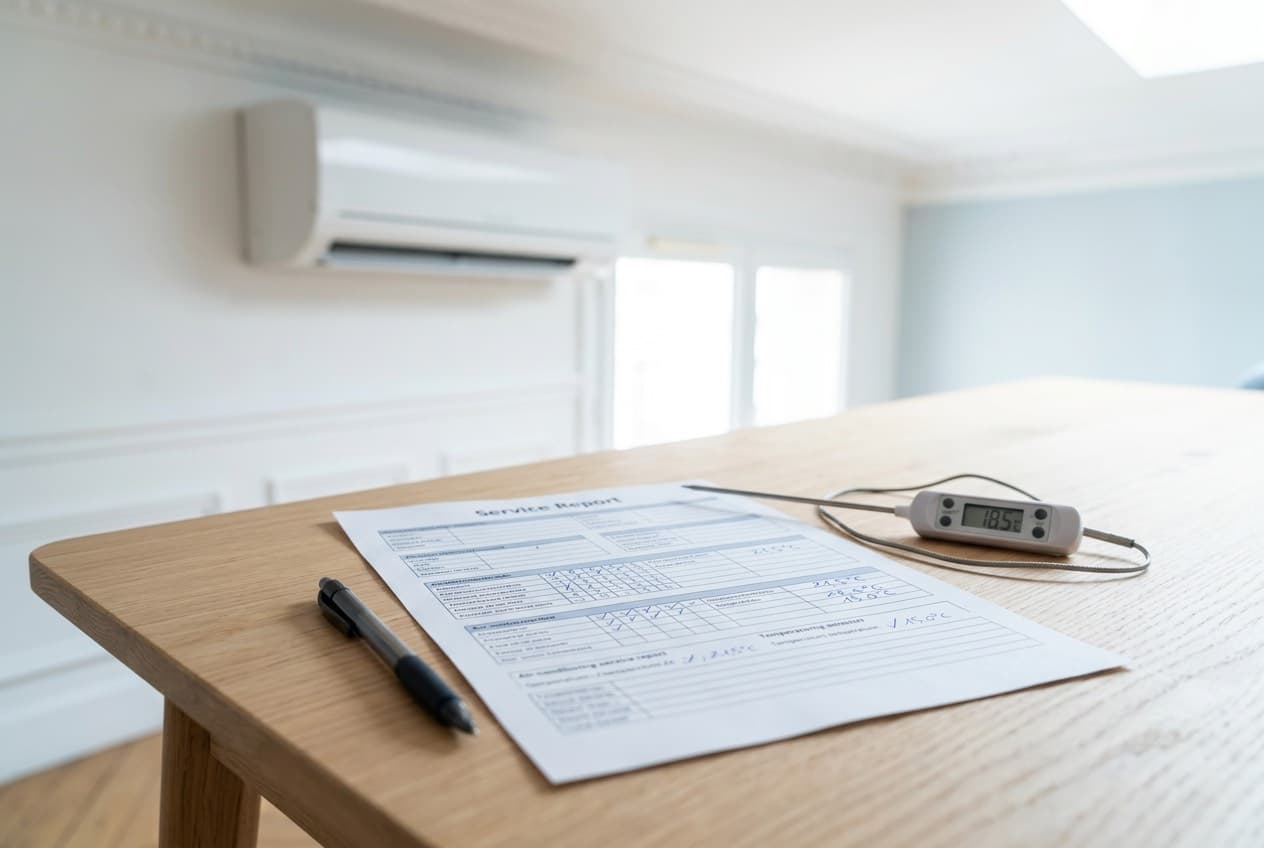
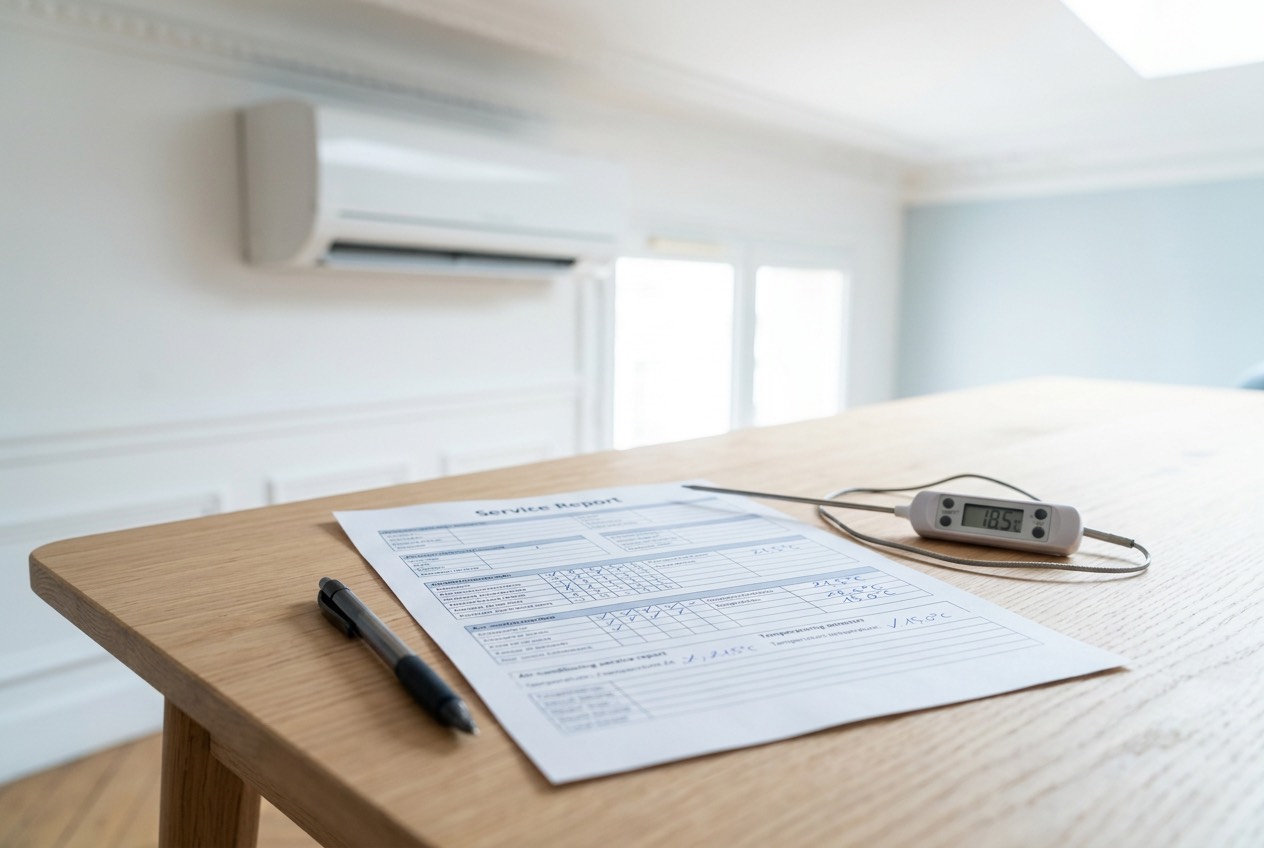
At the end of a visit you receive a document full of figures: degrees, amps, sometimes bar. Most people file it away unread. That is a pity, because these values are the only objective record of your air conditioner's condition on a given date.
Taken once, they describe a moment. Compared year on year, they show whether the unit is ageing normally or drifting. Here, line by line, is what an air-conditioning technician records, why, and how to read the differences without being in the trade.
"Everything is fine" proves nothing
A clean filter is visible. A fault that is just beginning is not. An air conditioner can still blow cool air while drawing more power than a year ago, or slowly losing refrigerant. Only a measurement will tell you.
A report with figures serves three purposes:
- comparison: this year's value against last year's, in similar conditions;
- evidence: regular servicing can matter for the manufacturer's warranty, the sale of a home or the end of a commercial lease;
- decisions: repair, monitor or leave alone, based on facts rather than impressions.
A useful report starts by identifying the unit: brand, model, serial number, refrigerant type and the charge shown on the rating plate. Without this information, readings cannot be tied to a specific piece of equipment, especially when your home or your business has several.
Measurement conditions: the line nobody reads
A reading is only meaningful in context. The same air conditioner gives different figures at 18 °C or 32 °C outdoors. A serious report therefore states:
- the outdoor temperature and the room temperature at the time of the reading;
- the operating mode (cooling or heating);
- the fan speed used, often the highest, to stabilise the values;
- how long the unit ran before measuring: it needs about ten minutes for its values to settle.
If two reports were drawn up in very different conditions, one in June and one in November for example, compare them with caution. A difference of a few degrees or a few tenths of an amp may come from the weather, not the unit.
Return and supply air: the difference that says a lot
The return temperature is that of the air drawn into the indoor unit, in other words the room air. The supply temperature is that of the air leaving the louvres. The difference between the two is the simplest indicator, and one of the most revealing.
In cooling mode, on a wall-mounted unit in good condition with a high fan speed, this difference is often between 8 and 15 °C. That is an order of magnitude: it depends on the model, the fan speed and the room's humidity, since part of the energy goes into condensing moisture from the air rather than cooling it. What really matters is the trend from one visit to the next, and whether it is consistent with the airflow.
A temperature difference is never read on its own:
| What you see | Most frequent explanation |
|---|---|
| Smaller difference than last year, normal airflow | Low refrigerant, struggling compressor, dirty outdoor unit |
| Larger difference than usual, little air coming out | Clogged filter, dirty fan or indoor coil |
| Correct difference but the room stays warm | Undersized unit or large heat gains |
| Difference fluctuating widely during the reading | Unstable control, temperature sensor to check |
The second case often surprises people: a dirty unit can show a flattering figure. Air passes slowly over a very cold coil, so it cools a lot, but very little of it gets through. The cooling actually delivered to the room falls, and the coil may eventually ice up.
Current draw: what the unit really consumes
Current is measured in amps, with a clamp meter, on the outdoor unit's supply. The technician compares it with two references: the rated value on the plate and readings from previous visits. Voltage is often recorded too, around 230 V: an abnormally low voltage can point to a loose connection or an undersized circuit.
Almost all current air conditioners use inverter technology: the compressor adjusts its speed to demand, so the current varies constantly. That is why comparisons only make sense in similar conditions, ideally in test mode when the manufacturer provides one.
Two trends deserve attention:
- current rising in equal conditions: a compressor under strain, an obstructed outdoor coil, a fan slowing down;
- very low current while the room does not cool: a compressor that does not ramp up, or a circuit short of refrigerant.
A unit that draws more power for the same cooling costs more every month. That is the direct link between the reading and your bill, and one of the reasons behind our commitment to energy efficiency.
Pressures, superheat and subcooling
These lines appear when the technician has connected gauges to the refrigerant circuit. They show the low pressure (evaporating side) and the high pressure (condensing side), in bar. Raw pressures say little: they are converted into saturation temperatures, which show the temperature at which the refrigerant evaporates and condenses.
Two calculated values complete the picture:
- superheat: the difference between the actual temperature of the suction pipe and the evaporating temperature. It shows whether the evaporator is properly fed. Too high points to low refrigerant or a faulty expansion device; too low points to overcharging or insufficient airflow;
- subcooling: its counterpart on the liquid side, useful for judging the charge on some units.
You will not necessarily find these values at every visit, and that is normal. Each connection releases a small amount of refrigerant and can let moisture into the circuit. On a domestic split whose temperature difference and current are consistent, there is no reason to open the circuit. Gauges are connected when those two indicators raise questions, after a repair, or during a leak check.
A refrigerant circuit is sealed. A healthy unit does not "use up" refrigerant: if some is missing, there is a leak, and topping up without finding it only postpones the problem. Any handling of refrigerant is restricted to companies holding the French refrigerant handling certificate (attestation de capacité) and is recorded on an intervention form.
Leak detection
The technician runs an electronic detector over the sensitive points: pipe connections, outdoor unit valves, brazed joints, sometimes backed up with a bubble solution. The report should say which points were checked and with what result, not just "no leak".
For equipment whose charge exceeds 5 tonnes of CO2 equivalent, leak checks are periodic and mandatory. The report then gives the date, the result and the next due date. We explain the thresholds and frequencies in our article on leak checks and the F-Gas regulation.
The other lines in the report
Beyond the figures, a complete report records:
- the condition of the filters, coil and fan, before and after cleaning;
- a flow test of the condensate tray and drain line;
- mountings, anti-vibration pads and pipe insulation;
- tightness of accessible electrical connections, and operation of the remote control and sensors;
- photos, where they clarify a finding;
- recommendations ranked by priority, each priced separately.
A recommendation is not an obligation. At ClimExpertise, no repair is carried out without your written consent: the report gives you time to decide.
Comparing two reports in five minutes
- Check that the measurement conditions are similar: same mode, comparable outdoor temperature.
- Look at how the temperature difference has changed, bearing the airflow in mind.
- Compare the current draw in equal conditions.
- Spot any new remarks: wear, oil traces on a connection, noise.
- Check that last year's recommendations were dealt with or knowingly postponed.
Between visits, nothing stops you keeping an eye on the room yourself. An indoor thermometer hygrometer lets you note temperature and humidity, and a probe thermometer held in front of the louvres gives an idea of the supply air. These readings do not replace a professional measurement, but they help you report a change. Never open the unit, though, and leave the electrical connections alone.
What we do with these figures
Every ClimExpertise visit ends with a written report setting out these readings in plain language. Each unit's history is kept: it is the basis of our active vigilance. We compare readings year on year and get back in touch before the next season, or before a leak check falls due.
Has your air conditioner gone more than a year without being measured? For €130 including VAT (one indoor and one outdoor unit, travel included throughout Île-de-France), our air conditioner servicing and cleaning covers these readings and explains them. Choose your slot on the booking page.
Have your air conditioner checked by an expert