Sleeping well with air conditioning: night mode and noise

L'équipe ClimExpertise
11 Nov 2026 - 09 min to read

A bedroom can be at 23 °C and still be a bad place to sleep. All it takes is air blowing straight onto the bed, a fan that changes speed every ten minutes, or air so dry that you wake up with a sore throat. The thermometer says "all good", your body says otherwise.
Night-time is when an air conditioner is hardest to set up properly, for one simple reason: the need for cooling drops sharply just as sensitivity to noise and draughts rises. Here is how to set up a bedroom, what a technician's readings reveal about noise and humidity, and what counts as an adjustment rather than a repair.

Why night-time calls for different settings than daytime
During the day, an air conditioner fights the sun on the façades, heat from appliances and people coming and going. At night, almost all of those gains disappear. What remains is the heat stored in the walls, the heat given off by the occupants, and outdoor air that only cools down slowly in the city.
Two concrete consequences:
- the useful output drops. A unit sized for the afternoon becomes oversized at 2 a.m. If it is not inverter technology, it starts, reaches the setpoint, stops, then starts again. Those cycles are what you hear;
- dehumidification matters more. A body at rest tolerates overly dry air just as poorly as overly humid air. The comfortable range is narrower than during the day.
In Paris and the Île-de-France, one more factor comes into play: the urban heat island. Météo-France and ADEME (the French Agency for Ecological Transition) have documented it for several years: in the dense city centre, night-time temperatures commonly stay several degrees above those in peri-urban areas. Opening the windows at 1 a.m. in a flat in the 11th arrondissement does not bring the same coolness as in a house in Seine-et-Marne — and it lets in street noise.
The night-time setpoint: a few degrees higher, not lower
The most common mistake is lowering the setpoint at bedtime "to be sure of staying cool". You should do the opposite.
During sleep, body temperature naturally falls. The metabolism produces less heat. A room that felt pleasant at 10 p.m. feels cold at 4 a.m., especially in the area reached by the airflow.
Some sensible benchmarks, to adapt to how you feel:
| Situation | Suggested night setpoint |
|---|---|
| Mild night after a hot day | 25 to 26 °C |
| Heatwave night, still 27 °C outside | 24 to 26 °C |
| Bedroom with two occupants, poorly insulated room | 24 to 25 °C |
| Shoulder season, more need to dehumidify than to cool | dry mode, high setpoint |
ADEME recommends a general benchmark of 26 °C in summer for a home, along with a limited gap with the outdoor temperature. For a bedroom, that logic holds even better: the goal is not cold, it is to stop the room from staying above 27 or 28 °C all night.
One often-overlooked point: the setpoint shown on the remote corresponds to the temperature measured at the indoor unit, usually high up on the wall. And warm air rises. It is not unusual to measure 1 to 2 °C less at bed level. To find out what you are really experiencing, measure at pillow height with an indoor thermometer and hygrometer and compare over two or three nights. It is the single most useful measurement you can take on your own.
Humidity: the parameter that decides real comfort
At 25 °C, a bedroom at 45 % relative humidity is comfortable. The same room at 70 % feels clammy, and at 30 % it dries out your airways. The range generally recommended for a home is between 40 and 60 % relative humidity.
Two kinds of imbalance, two different settings:
- Air too humid (clammy feeling, sticky sheets, musty smell): the air conditioner cools too quickly and shuts off before it has dried the air. Switch to dry mode, or lower the fan speed while keeping the same setpoint. Air that passes more slowly over the heat exchanger cools down more on contact, so it condenses more.
- Air too dry (blocked nose on waking, sore throat, dry eyes): the machine runs too long relative to the actual need. Raise the setpoint by one degree, increase the fan speed slightly, and avoid running the unit all night if the room stays stable without it.
Beware of a common reflex: adding a humidifier to an air-conditioned room. It can help in a very dry home in winter with an air-to-air heat pump, but in summer it amounts to making the air conditioner work against the humidifier. Better to correct the setpoint first.
We explain how dry mode works and the trade-offs in extreme heat in our article on air conditioner settings during a heatwave. This article focuses on what changes once the lights go out.
Noise: where it comes from, and what is abnormal
A bedroom air conditioner that is well installed and clean is barely audible. When it becomes a nuisance, you need to tell settings issues apart from genuine faults.
Normal noises
- The airflow from the indoor unit. It increases with fan speed. This is the noise you control most directly.
- Light creaking at start-up and shutdown: expansion of the plastic casing and the heat exchangers.
- A faint trickling or gurgling: condensate heading to the drain.
Noises worth having checked
- A metallic rattle or a regular rubbing sound: a dirty or unbalanced fan wheel, or contact with part of the casing.
- A low hum that travels through the wall: vibration transmitted by the outdoor unit's brackets or by poorly isolated refrigerant piping.
- A continuous high-pitched whistle: have it checked, as it can accompany a fault in the refrigerant circuit.
- A dull thud each time the compressor stops on a unit that restarts very often: a sign of short cycling, often linked to an oversized unit or a dirty heat exchanger.

Outdoor unit noise and your neighbours
This is the issue that causes the most disputes in Parisian apartment buildings. The Code de la santé publique (French Public Health Code) regulates neighbourhood noise: article R. 1336-7 and the following articles define the offence in terms of emergence, that is, the difference between the ambient noise with the unit running and without it. The thresholds are stricter at night (the 10 p.m. – 7 a.m. period) than during the day. In other words, an outdoor unit that is acceptable in the daytime can become contentious if it runs at night in an enclosed courtyard, where sound bounces between the façades.
Three practical levers, in order:
- switch on the outdoor unit's quiet mode if the equipment has one: it limits the fan speed and caps the compressor's output;
- check the vibration isolation: anti-vibration mounts in good condition, brackets tightened, pipes not in direct contact with the masonry;
- have it measured with a sound level meter before and after correction, preferably at night, so you have a written record in case of discussion with the building manager.
A dated noise reading is worth more than an argument on the stairwell. It follows the same logic as our written report after every intervention: figures, measurement conditions, and a comparison that remains possible the following year.
Night mode, quiet mode, scheduling: what does what
The names vary by brand, but three distinct functions turn up almost everywhere. The manual always confirms it: read it once and you will save yourself months of trial and error.
- Night mode (sometimes "sleep", "good sleep", "night comfort"): it gradually raises the setpoint, often by 1 °C after an hour and then another 1 °C, and reduces the fan speed. It is the most useful function in a bedroom, because it follows the natural drop in demand.
- Indoor unit quiet mode: it forces the lowest fan speed. Useful, but it also reduces dehumidification. Avoid it on muggy nights.
- Timer scheduling: delayed shutdown or delayed start. Often the best solution in a well-insulated flat: cool the bedroom an hour before bedtime, then let the unit switch off in the middle of the night. The room drifts by 1 or 2 °C, which is usually imperceptible during deep sleep.
Three scenarios that work
Parisian flat, upper floor, heatwave night. Start cooling at 7 p.m. with the shutters closed, setpoint 25 °C, medium fan speed. At bedtime: night mode on, airflow directed towards the ceiling, bedroom door ajar. The unit runs all night at low output, which is quieter and more efficient than on-off cycling.
House in the inner suburbs, night dropping to 19 °C. No air conditioning overnight. Cool the room before bedtime, stop it on the timer an hour later, and open windows for cross-ventilation if outdoor noise allows. A quiet bedroom fan is an excellent complement: it creates air movement that gains 2 to 3 °C of perceived temperature for ten to twenty times less energy than an air conditioner.
Humid bedroom, shoulder season, 23 °C and 72 % humidity. Dry mode, high setpoint, low fan speed. If the humidity comes from another source (laundry drying, a cold wall), a dehumidifier can help, but it warms the room slightly: save it for mild nights.
Airflow: the free setting almost nobody uses
Many complaints blamed on noise or cold actually come from the direction of the airflow. A stream of 14 °C air sweeping across a shoulder for six hours causes a stiff neck and night-time waking, even in a room at 25 °C.
The rule is simple: the airflow must never touch the bed. Point the horizontal louvres upwards, as close to the ceiling as possible, and let the air come back down through mixing. If the unit faces the bed and nothing can be changed about that, an air conditioner deflector that clips onto the grille redirects the airflow. It is the best-value accessory for an air-conditioned bedroom.
Another detail that is useful in the Île-de-France, where many bedrooms face the street: residual fan noise is less bothersome when the ear has something else to listen to. Comfortable foam earplugs or a small white-noise generator sometimes solve in one night what weeks of adjustments could not.
What maintenance changes for noise and sleep
A dirty indoor heat exchanger does three things at once: it reduces airflow, and therefore comfort; it increases noise, because the fan wheel is working in an obstructed air path; and it degrades dehumidification. Musty smells at start-up have the same origin, as we explain in our article on the air conditioner that smells bad.
What you can do on your own, with the unit powered off:
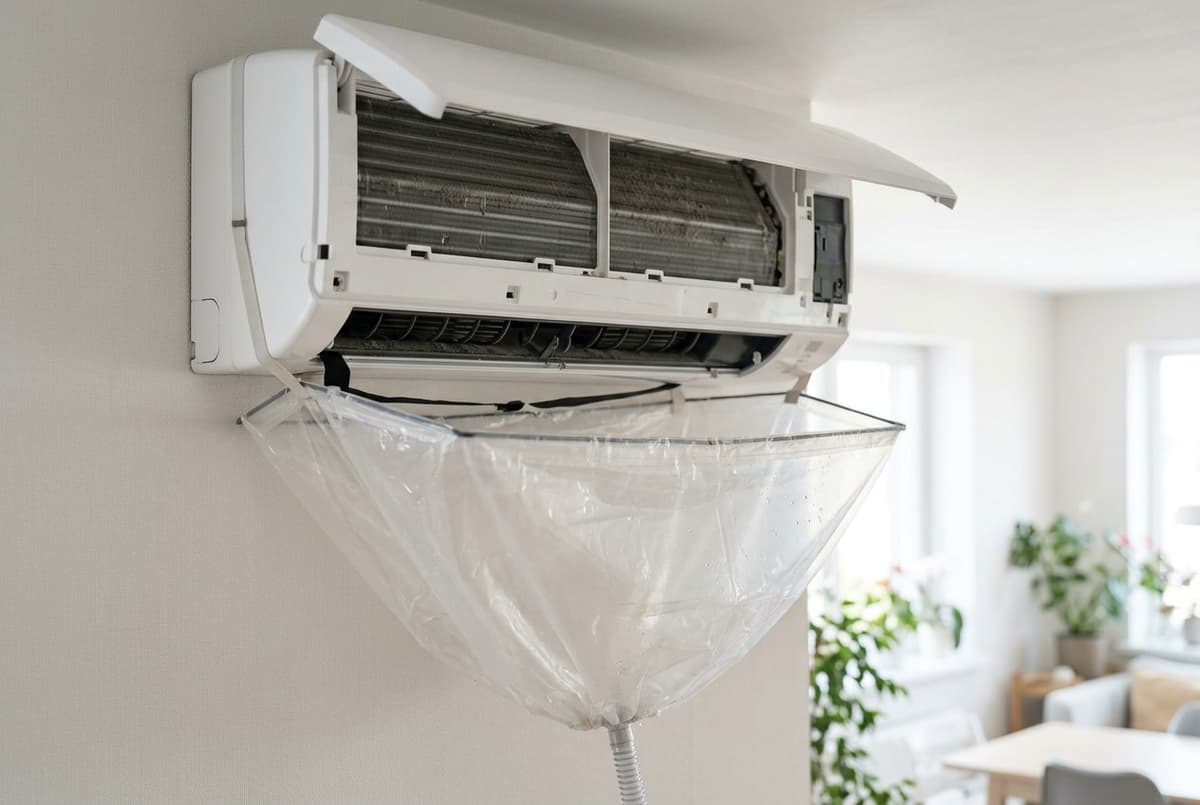
- remove and rinse the filters every two to four weeks during the season of use, and let them dry completely;
- dust the return air grille and the front panel;
- check that nothing is blocking the outdoor unit: leaves, cardboard, balcony furniture.
For the filters and the grille, a soft-bristled air conditioner cleaning brush avoids bending the fins. Beyond that, stop: deep cleaning of the heat exchanger, the condensate tray, the fan wheel and any work on the refrigerant or electrical circuit are jobs for an air conditioning technician. For reference, a full service costs €130 including tax for one indoor unit and one outdoor unit, with +€40 per additional indoor unit and +€70 per additional outdoor unit, VAT at 10 % in homes more than two years old, and no travel charge anywhere in the Île-de-France.

When adjusting is no longer enough
Some night-time symptoms cannot be fixed with the remote. They deserve a proper set of readings: supply and return air temperatures, the difference between the two, current draw, and behaviour at start-up.
- The unit starts and stops every five to ten minutes: short cycling. Dirt, an incorrect refrigerant charge, or oversizing.
- The noise has changed over the past few weeks, with identical settings.
- The bedroom no longer drops below 27 °C when it managed to the previous summer.
- Water appears under the indoor unit, or marks show up on the wall.
- An error code shows up at night then disappears by morning.
In these cases, a diagnosis backed by figures beats replacing parts at random. Our repair visits generally take place within 24 to 72 hours across the Île-de-France, and the decision to repair or replace is based on the measurements, as detailed in our article on whether to repair or replace an air conditioner more than ten years old.
Key takeaways
- At night, raise the setpoint: 24 to 26 °C is almost always enough in a bedroom.
- The airflow must never reach the bed: towards the ceiling, always.
- Clammy air: low fan speed or dry mode. Air too dry: higher setpoint, shorter running time.
- Measure at pillow height, not just by reading the remote.
- A new noise, short cycling or water appearing are not matters of settings.
A well-adjusted bedroom uses less energy, is heard less and causes fewer arguments with the neighbours. If yours resists despite these settings, book a maintenance visit: the readings will tell you whether the problem lies with the unit, its settings or its sizing. For broader needs, our commitments describe what we measure and what we write in every report.
Have your air conditioner checked by an expert